


Furthermore, Pope Francis's apostolic journey in March 2021, when the world was struggling to recover from the Covid-19 pandemic; and the realisation of having served "a martyred Church, which has so much to offer the universal Church".
Related: Timeline of ISIS in Iraq
Related: Attacks on Assyrians in Syria By ISIS and Other Muslim Groups
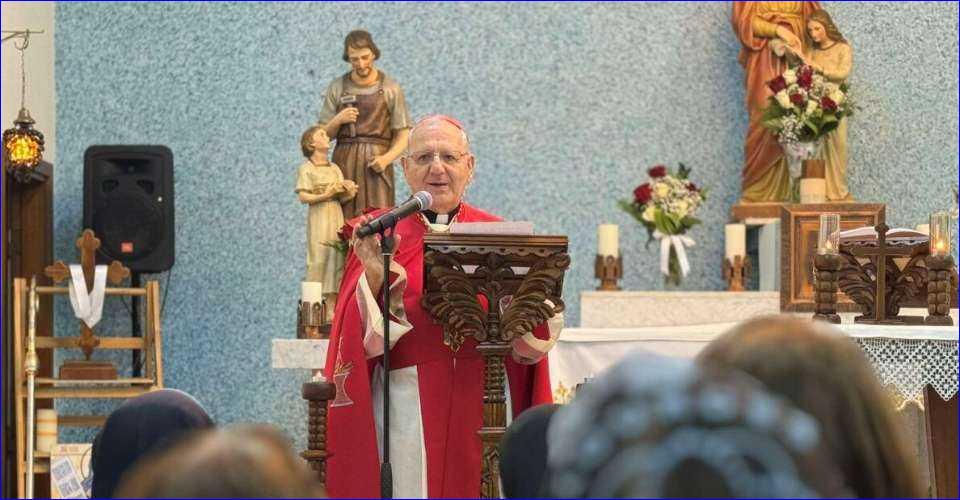
These are some of the reflections that Cardinal Louis Raphael Sako, Patriarch Emeritus of the Chaldeans of Baghdad, shares with AsiaNews in this interview, more than four months after his resignation. A period spent reading, studying and praying: "I am at peace, I live in tranquillity, and I pray with the seminarians in a family-like atmosphere. "People," he says, "come to visit me; I help those in need as best I can. Above all, I write: in four months I have finished my latest book, in Arabic, entitled *The Joy of Believing*, which is due to be published in the next few days. And I have set up a Facebook page where I post brief reflections."
A bridge between East and West
In his reflection, the cardinal begins immediately by addressing the devastation caused by the conflicts that are ravaging the Middle East and which have their roots in a lack of understanding and the difficulties of dialogue between East and West. "The world is divided. The West," he observes, "is based on economic interests, secularism, pragmatism and weapons, and struggles to understand the logic of an East that is profoundly different, where religion becomes not only a doctrine but also an ideology" that shapes every aspect of life. "People," he continues, "are prepared to die for ideology and faith, and therein lies the value of martyrdom" which we have witnessed in recent days during the funerals of Supreme Leader Ali Khamenei, both in the Islamic Republic and in Iraq. "If we take the war between Iran and the United States as an example," he emphasises, "we can see two ways of thinking and reasoning that are fundamentally different from one another."
Cardinal Sako was born in Zākhō (northern Iraq) on 4 July 1949. He completed his primary education in Mosul, before attending the local St Jean seminary, run by the French Dominican Fathers. Ordained a priest on 1 May 1974, he carried out pastoral work at Mosul Cathedral until 1979. Sent to Rome, he studied at the Pontifical Oriental Institute, obtaining a doctorate in Oriental Patrology, followed by a doctorate in History at the Sorbonne in Paris and a licentiate in Islamic Studies.
From 1997 to 2002, he served as rector of the Patriarchal Seminary in Baghdad. Upon his return to Mosul, he took charge of the Parish of Perpetual Help until his election as Archbishop of Kirkuk on 27 September 2003, with his episcopal ordination taking place on 14 November. On 31 January 2013, at the synod convened in Rome by Pope Benedict XVI following the resignation of Patriarch Cardinal Emmanuel Delly, he was elected Primate and received the Ecclesiastica Communio from the Pope on 1 February. On 28 June 2018, Pope Francis created him a cardinal. He is a member of the Dicastery for the Oriental Churches, for Culture and Education, for Interreligious Dialogue, and of the Council for the Economy.
"We must come to terms with a civilisation -- the Persian civilisation -- which is millennia-old and combines doctrine and religious faith, the concept of jihad as an armed struggle to the point of ultimate sacrifice, as well as death for one's country and religion," states Cardinal Sako. "The way of thinking and reasoning," he warns, "is different, and this is where the question arises as to how it is possible to establish a dialogue. And the answer is neither easy nor immediate." When discussing Iran, it is essential to understand that "we are not merely dealing with a political phenomenon; we must also take the religious dimension into account. And this element is absent in the West." "In our Eastern world," he adds, "priority is often tied to religion, unlike in the West, where politics and economic interests usually prevail." As has been observed on several occasions in the past, in this sense Christians (and the Church) can play a fundamental role as a bridge between the two cultures, between the two hemispheres of the globe which often struggle to communicate and understand one another: "Peace is not achieved through weapons!"
Patriarch for the whole of Iraq
During his 13 years at the helm of the Chaldean Patriarchate -- one of the oldest rites of the Eastern Church but deeply linked to Rome and the Pope -- there has been no shortage of challenges and dramatic moments, starting with the tragedy of ISIS, which "affected me deeply: their rise has undoubtedly been the most significant event in the recent history of Iraq and its Christians", with the displacement of hundreds of thousands of people in Mosul and the Nineveh Plain. In recent years, a slow process of reconstruction has begun, which is struggling to ensure security and stability despite the efforts of the Church and the Iraqi government, rendering calls for the return of the diaspora communities futile so far. A veritable exodus which, since 2003 following the US invasion and the fall of Saddam Hussein, has led to a collapse in the Christian population, which has fallen from 1.3 million to fewer than 400,000 today. And it is to them that the cardinal's thoughts turn. "Before talking about a return [as promised by the Iraqi Prime Minister Ali Falih al-Zaidi to Patriarch Mar Paul III Nona, the cardinal's successor, at a meeting on 11 July]," observes Sako, "we must examine the conditions that drove Christians to leave."
Lasting stability, an environment in which people can live in peace even if they have lost faith in the possibility of achieving it; the prevalence of sectarian affiliations and divisions over the concepts of citizenship and justice; the lack of compensation for damage caused by Daesh [the Arabic acronym for ISIS] and Christian property confiscated by militias, which has not been returned; the spread of corruption; and the deterioration of essential services are just some of the many unresolved issues. "There is a lack of job prospects," he continues, "as well as infrastructure, schools, services and hospitals. Christians will not return unless the culture and laws change, with the establishment of a state founded on citizenship rather than on confessional divisions, and with a reform of the laws. In particular," explains the Patriarch Emeritus, "those relating to the Islamisation of minors and the appropriation of their rights and property. Furthermore, there is still a continuous exodus due to emigration. These are central, and unresolved, issues!"
Security, employment, services and the fight against "endemic corruption" are areas that affect the entire population and Iraq as a whole, a nation -- the cardinal reiterates once again -- that should "base its reconstruction on the value of citizenship". "In many of my speeches," recalls Cardinal Sako, "I have spoken not only on behalf of and to Christians, but also to Muslims, calling for the separation of religion from the state, and for the creation of common ground where all citizens enjoy equal dignity and their rights are respected." He then recalls the significant work carried out in favour of Islamic-Christian dialogue, which "has made great strides in recent years" and is evidenced by meetings with Sunni, Shia and Kurdish authorities, starting with Grand Ayatollah Ali al-Sistani, the most important Shia Muslim leader in the Arab country, "whom I have visited twice in Najaf". "Thanks to these efforts," he observes, "and to the relationships built up over time, we have been able to put an end to hate speech. Christians are no longer spoken ill of in the mosques!" "The only thing that struck me and caused me pain," he adds with a note of bitterness, "is the withdrawal of the patriarchal decree issued by the then-president Abdul Latif Rashid, behind which lay the manoeuvring and interests of a so-called Christian militia. However, I have always refused to have Christian militias or sectarian militias." "Before appealing to Christians to return," he emphasises, "the Church must help those Christians who have remained, and give them hope."
The Challenges Facing the Church
Having recently returned to Iraq after attending the last consistory convened by Pope Leo XIV at the end of June, the cardinal then turns his attention to the universal Church and the future of the mission. "The recent synodal experience," he says, "has been a source of satisfaction, because we in the East have been living it for some time. The Synod is a place and an opportunity for working together, for studying problems and challenges, desires and plans, and for making decisions together. This is the Church born of the pontificate of Pope Francis, who emphasised the theme of synodality, of walking together. This aspect is very positive." And regarding his successor, Pope Leo XIV, he says he appreciates his speeches, which are "brief and to the point, using language that speaks to the people. Pope Leo is no longer the head of a dicastery of the Roman Curia, but is the father and shepherd of the entire Catholic Church.
"I hope," he adds, "that his message is for everyone, not just for the West, because we need to speak to the whole world. And his apostolate is not just for Christians, but for everyone when he calls for peace, coexistence and dignity, and for how to engage with other religions, especially Islam."
In an age characterised by speed, the internet and artificial intelligence, in which the Church risks appearing 'slow' and 'wasting' time, he urges us to find new ways forward and 'immediate responses' capable of speaking to today's society. 'It is necessary,' he reflects, 'to seek an approach based on dialogue. People do not accept being guided as mere subjects. We bishops are fathers and shepherds; we must know how to understand them and adopt a style of paternal and fraternal dialogue." As for the Chaldean community, which is getting to know his successor, Patriarch Nona, the cardinal reiterates once more that he "will not comment on the direction or decisions taken, but will remain discreet. My time," he emphasises, "has come to an end, and now a new phase begins." "Every day," the cardinal confides, "I pray for the Patriarch, for the bishops, but above all for the Chaldean Church, which is and remains a martyred Church that has much to offer the universal Church in terms of liturgy, spirituality and biblical pastoral care -- not merely scholastic or philosophical." And as for Iraq and its Christians, the cardinal concludes, "I am sure that the situation will change for the better; there will be full religious freedom and the Chaldean community will continue to grow. I pray for this."
or register to post a comment.