


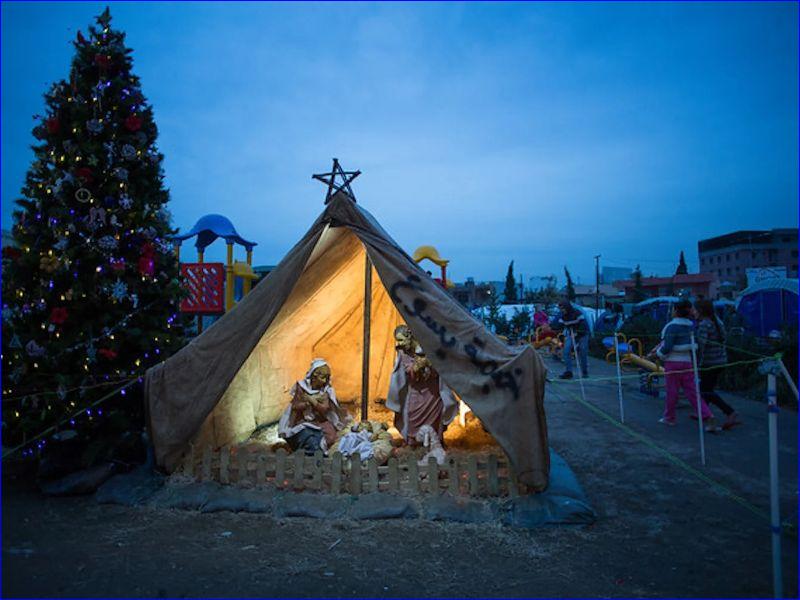
"It feels like a token move to appear non-discriminatory," said "Petros," an Assyrian Christian living in the U.S. with an Iraqi expat family. He added that this "token" celebration of Christmas "ignores the native traditions" of the region's Christians and "instead opts for a European-style Christmas" with Santa Claus and various types of Christmas trees that don't naturally grow in the area.
Iraq, which was already celebrating the birth of Christ when most of Europe was still pagan, has among the world's oldest Christian communities, with the faith arriving in the first century A.D.
Petros feels that the Iraqi government's acknowledgment of Christmas is more of a public relations strategy to deflect from the recent horrors faced by Iraq's Christians.
"Yonita," an Assyrian woman who is Chaldean Catholic and lives in the U.S., believes the recent recognition of Christmas is financially motivated.
"Iraq is trying to rebuild itself," she said, adding that it might be "taking notes" from more successful countries in the region that have comparatively more religious freedom.
Yonita suspects that celebrating Christmas could be an attempt at showing camaraderie with the West. It could also be a way to make the homeland seem more congenial to the many Iraqi Christians abroad.
As she pointed out, the Christian Iraqi diaspora tends to be quite well-off financially.
"There was a formal call inviting us back to Iraq [to] invest in the rebuilding of the cradle of civilization," Yonita said.
A Sad Reality
Whatever the Iraqi government's true motivation, one painful aspect is hard to deny: By the time Christmas became a national holiday, most Iraqi Christians had already been driven out of their homeland. Conditions were so difficult during the previous 15 years that the country had lost up to 90% of its Christian community.
Iraq's remaining Christians, most of whom belong either to the Chaldean Catholic Church or the Assyrian Church of the East, now comprise less than half of 1% of the country's overall population.
The Christian population had already seen considerable decline during the 24-year reign of former Iraqi president Saddam Hussein, a man of immense sadism. But, for all his homicidal flaws, Hussein -- though Muslim by background -- was no Islamic extremist. In fact, his longtime right-hand man, Deputy Prime Minister Tariq Aziz, was a Christian, at least technically.
It would likely be an exaggeration to say that Hussein cared about the welfare of Iraqi Christians, but the bone-crushing force of his reputation rendered most Iraqis, regardless of their faith, too intimidated to indulge in sectarian hostilities.
Petros said that his fellow Assyrian Christians "either liked Hussein for providing stability and jobs, or hated him for killing their family members."
Many of Iraq's Christians wanted him to stay in power only because they had an acute sense of the mayhem that would erupt after their secular tyrant was deposed.
"It's like the saying goes," Petros said. "Better to deal with the devil you know than the devil you don't." At this point, though, both "devils" have fully acquainted themselves with Iraq.
The Rise of Extremism
The ousting of Hussein from power in 2003 brought in an era of rising Islamic extremism, most notably with the Islamic State group (ISIS), formerly known as "al-Qaida in Iraq." Some Iraqi Christians were even accused of collaborating with the U.S. military.
As the atmosphere grew increasingly precarious in post-Hussein Iraq, most Christians fled the country, having decided the other options -- violent death, forced conversion, or paying a religious tax -- were unpalatable. Those who remained were often hunted.
In June 2007, in the northern Iraqi city of Mosul, a priest and his assistants were killed right in front of his church. For several hours afterward, nobody retrieved their bodies. The danger had reached such an extreme that it was assumed anyone who appeared on the scene would themselves fall victim to an ensuing burst of violence.
In February 2008, Mosul's Chaldean Catholic archbishop was forcibly abducted from his car in an incident that saw his driver and bodyguards killed at the scene. The archbishop himself was not seen alive again. He had warned his people never to pay a ransom for him, fearing that any such money would only finance more evil pursuits.
Iraqi authorities tried to combat the extremists but ultimately failed to protect religious minorities. Petros feels that a significant portion of Iraqis were content to let the extremists abuse and eradicate religious minorities.
He cited the "Sunni Arab population" and the "Kurdish political class" as the two groups most consistently hostile toward Iraq's Christians. He added that these two groups currently represent the biggest threat to Christians who have remained in Iraq.
Threats Remain
Though the ISIS menace has been diminished in Iraq, much of the country remains vulnerable to the threat of various militia groups -- including Shia militias backed by neighboring Iran.
The U.S. Department of State said that the number of Iraqi Muslims who converted to Christianity is unknown. A separate report claims that more than 5,000 Iraqi Muslims have converted to Christianity since the early 2000s.
Petros said he has never met an Iraqi Muslim convert to Christianity. Suffice it to say their predicament would be tenuous. After all, conditions have been problematic enough even for believers from ancient Christian families.
Iraqi Christians have reported facing increased difficulty in securing desirable employment and have also faced the confiscation of their land and homes.
Despite all the carnage and the much-reduced state of Iraqi Christendom, Petros feels there remains a chance at a sustainable future for Christians in Iraq. But, he added, it "requires a serious effort" from the government as well as Iraqi Christians both in the homeland and in the diaspora.
or register to post a comment.