


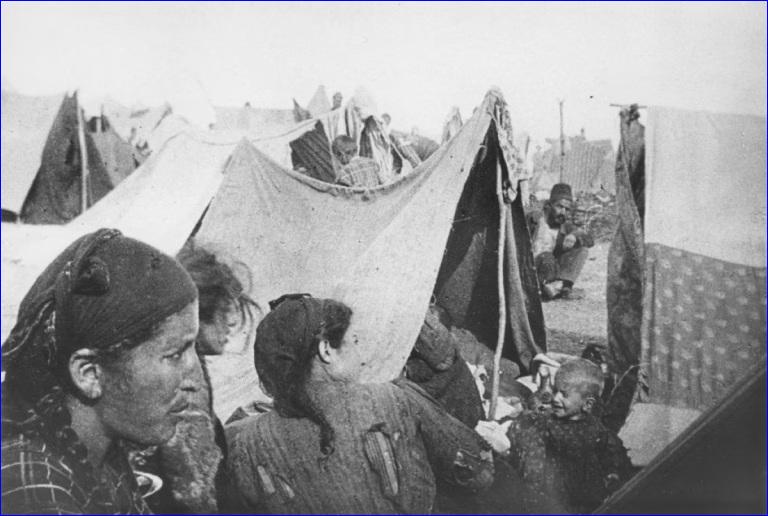
Their fears proved justified. In June, Ottoman authorities arrested a group that included 230 Armenian Catholics, 143 Assyrian Catholics and 27 Protestants. The prisoners were chained together, marched along the road between Merde and Omid (Diyarbakir), and killed.
Related: The Assyrian Genocide
The episode illustrates a central argument in historian David Gaunt's recent article, The Intertwining of Armenians and Assyrians in Ottoman Genocides, namely, the destruction of Armenians cannot be fully understood without examining the parallel persecution of Assyrians. Although distinct, the communities lived in close contact and were often targeted in the same places by the same perpetrators. Gaunt traces how state policy, nationalism, local rivalries, and the pursuit of property converged to devastate them.
A Shared World
For centuries, Armenians and Suroye lived alongside one another across eastern Anatolia and northern Beth Nahrin (Mesopotamia), regions that today include parts of southeastern Turkey. Both maintained ancient Christian traditions, but neither community was internally uniform.
Suroye in these regions belonged then, as they do today, to different Churches, including the Assyrian Orthodox and Assyrian Catholic Churches, among others. Armenians likewise included Armenian Apostolic, Armenian Catholic, and Protestant Christians. Religious affiliation shaped communal life, but it did not necessarily determine whom people spoke to, traded with, or regarded as neighbors.
Gaunt emphasizes the extent of these everyday connections. In some areas, Suroye spoke Armenian, with intermarriage and shared local customs also linking the communities. These ties did not erase religious and cultural differences, but they placed Armenians and Suroye within the same social world.
Communities maintained separate institutions and had different relationships with Ottoman authorities, but people who shared towns, markets, and family connections could be targeted by the same campaign. Gaunt challenges the idea that the Ottoman genocides were separate episodes affecting unrelated populations.
Violence Before the War
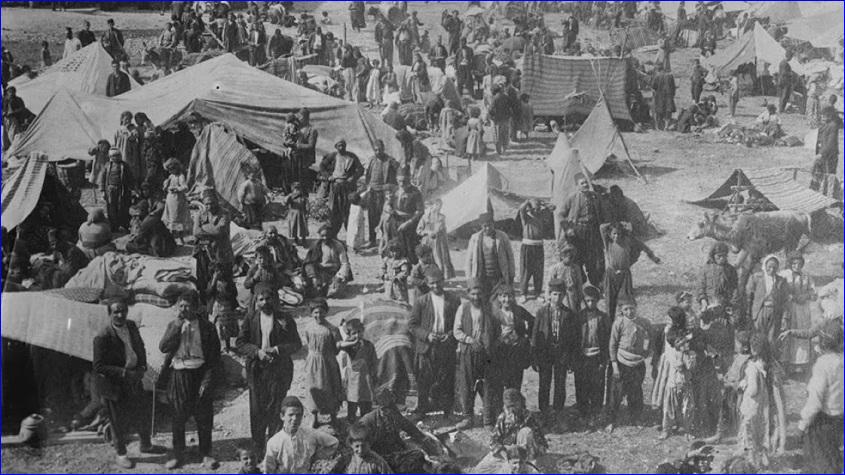
The attacks of 1915 did not emerge from an entirely peaceful past. During the nineteenth century, Suroye and Armenians faced repeated violence, particularly in areas where local rulers and tribal leaders exercised substantial power.
In 1843, the Kurdish emir Bedir Khan attacked Suroye communities in the Hakkari region. Historical estimates place the number killed between 7,000 and 10,000. The attacks devastated settlements and exposed the vulnerability of Christian communities when local military power was turned against them.
A further wave of violence came in 1895, during massacres directed against Armenians and other Christians across the empire. In Omid, approximately 1,000 Armenians and 167 Suroye were killed, according to figures discussed in Gaunt's research. Christian homes and businesses were looted or burned, leaving survivors without property or livelihoods.
For Gaunt, these episodes show how religious hostility interacted with local politics and economic interests. Officials sometimes participated in violence, while local figures exploited unrest to seize land or settle disputes. Claims that Christians posed a security threat could justify attacks while their property rewarded perpetrators. The First World War transformed these recurring dangers into a much broader campaign of destruction.
War, Nationalism, and Property
The Ottoman Empire entered the First World War amid political instability and pressure to preserve its territory. The Committee of Union and Progress, commonly known as the Young Turks, pursued increasingly centralized and nationalist policies. During the war, government leaders came to view parts of the Christian population as potential internal enemies.
Beginning in 1915, Ottoman authorities organized deportations, mass killings, and dispossession on a vast scale against Armenians. Suroye communities also suffered devastating violence. Gaunt stresses, however, that the targeting of different Christian populations was not always identical or simultaneous. Officials made distinctions among communities, and orders could shift with political calculations. Still, the same institutions, officials, and armed groups could participate in violence against multiple populations.
Property was central to this process. Deportation did not merely remove people from their homes, it made their houses, farms, vineyards, orchards, shops, and livestock available for seizure. Money and jewelry were stolen as well. The destruction of communities therefore served political and economic interests at once.
Local beneficiaries could gain land and wealth, while the state could reshape the empire's population by removing people considered disloyal. Gaunt's account is more complicated than a story of ancient religious hatred. Identity operated alongside wartime paranoia, nationalist ideology, and material gain.
Beth Zabday and the Politics of Suspicion
Beth Zabday (Idil / Azech) offers a revealing example. Predominantly Suroye in population, the town had its own local identity and linguistic traditions. It became connected to the wider violence through the arrival of Armenian refugees.
Ottoman authorities portrayed Beth Zabday as a center of Armenian rebellion, casting the Christian population as a security threat and providing a rationale for military action. But German officer Max von Scheubner-Richter investigated the circumstances and concluded that the Christians had fortified themselves because they feared a massacre. Their defensive preparations could be understood as a response to danger, rather than proof of an organized rebellion.
Once labeled rebellious, a population's attempts at self-defense could be treated as evidence of guilt. Beth Zabday's resistance shows that Christian communities also organized defenses and relied on sympathetic neighbors. Gaunt's account cautions readers to weigh official claims about rebellion against the circumstances facing the accused.
Local Alliances and Shifting Loyalties
Kurdish leaders and other local actors played varied roles. Some participated in attacks against Christians, others protected them. Relationships could change over time, making it impossible to draw a simple line between communities or political groups.
During the massacres of 1895--96, Ibrahim Pasha, a leader of the Milli Kurdish confederation, protected Armenians in some areas. Yet in 1915, under his son's leadership, Christians in Viranshehir were killed or deported.
The contrast cautions against treating entire ethnic or religious groups as unified actors. Some local leaders protected Christians through longstanding ties or political calculation, others joined persecution. Muslim neighbors also sheltered Christians or resisted pressure to participate. The decisions of officials, elites, armed groups, and ordinary residents could determine who survived.
The Machinery of Persecution
In Omid province, Governor Mehmet Reshid Bey became a major figure in the persecution of Christians. Local notables, armed operatives, and criminal groups also played roles. Deportation routes became sites of mass killing, while officials and perpetrators exploited the vulnerability of people under their control.
Armenian prisoners transported on rafts down the Tigris River were reportedly told they were being resettled in Mosul. Instead, they were killed, and their valuables stolen. The episode captures a recurring feature of the genocide -- official authority and the language of relocation could conceal or facilitate destruction.
Gaunt also highlights the uneven treatment of different Christian groups. At one point, Ottoman Interior Minister Talaat Pasha instructed Reshid that the killings should concern Armenians, not other Christians. Such distinctions show that government policy was not always uniform. They did not, however, provide lasting protection for Suroye communities, which were targeted again after periods of relative respite.
Estimates cited by Gaunt suggest Assyrian Orthodox communities lost about 72 percent of their population in Omid province and 57 percent in Merde district. Estimated losses reached 97 percent among Armenian Orthodox communities in Omid province and 92 percent among Armenian Catholics. These figures are uncertain because displacement and incomplete records make exact counts difficult, but they convey the scale of devastation.
A Connected History of Destruction
The end of the First World War did not restore the world that had existed before it. Many survivors could not return home. Land had been seized, houses occupied, and businesses lost. Some found refuge elsewhere in the Middle East. Others settled in Europe or the Americas. The displacement transformed the geography of Christian life across the region.
For Suroye, the consequences included the loss of life, property, and institutions sustaining language, religion, and communal identity. Armenians suffered similarly profound losses, though the two histories were not identical.
Gaunt brings these experiences into a shared historical frame without treating them as interchangeable. His research shows how political power, fear, and material interests converged, turning neighbors into targets and making the removal of entire populations appear to solve a nation's imagined problems.
or register to post a comment.