


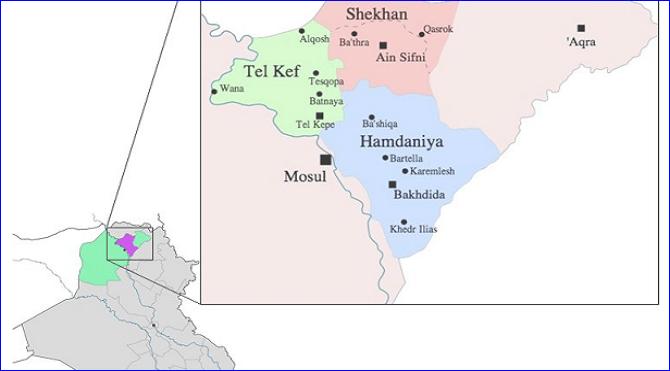
The United States completed the withdrawal of its remaining forces from Iraq on 30 September, ending a military mission that began with the campaign against the terrorist ISIS organization after the group seized large parts of the country in 2014. Washington has said that it will continue limited training and intelligence support, while responsibility for security shifts to Iraqi forces. The withdrawal has nevertheless raised concerns over Baghdad's ability to contain armed groups and prevent a resurgence of Islamic State sleeper cells.
For Sliwa, however, the central question is whether Iraq can finally bring all armed forces under the authority of the state. "I do not believe there will be a security vacuum," Sliwa told SyriacPress. "On the contrary, the withdrawal of the coalition is an opportunity to unify the military forces under the umbrella of the Iraqi state." He said the same principle should apply to the Nineveh Plain, an ethnically and religiously diverse region that has repeatedly been caught between competing military and political forces.
These Fears Are Being Exaggerated
Sliwa dismissed concerns that the withdrawal would automatically lead to a greater presence of Iran-aligned militias in the Nineveh Plain, arguing that some political actors were exaggerating the risks for their own interests. "I believe these fears are misplaced. There is an exaggeration, and there are political parties working to amplify these fears because of their own interests and their connections to the international coalition."
Instead, Iraqi security forces should take greater responsibility for protecting the region, while residents of the Nineveh Plain should be encouraged to join the army and security institutions. "The people of the Nineveh Plain should have a role in protecting their own areas through the institutions of the state," he said, referring to the army, national security and intelligence services.
His comments come as Baghdad faces pressure to bring armed groups under state control. The government has been seeking the disarmament of powerful militias, with the deadline for resolving the issue pushed to June 2027. Some of the most powerful Iran-aligned factions have resisted calls to surrender their weapons.
Sliwa said he nevertheless expected the armed factions to make further concessions. "I believe these armed factions will make more concessions during the coming period. They have realized that the process is serious and that this is a sensitive phase."
The memory of 2014 hangs heavily over the Nineveh Plain, where the Islamic State's offensive led to mass displacement and the destruction of communities. Sliwa argued that today's Iraq is fundamentally different from the country that collapsed before the terrorist Islamic State's advance.
"The current stage in 2026 is not the same as 2014." He suggested that the experience of the past 12 years had forced Iraqi political and security actors to learn lessons from the collapse of the state's defenses during the ISIS offensive.
Still, he acknowledged that political and military actors that had once benefited from the presence of the international coalition could now be facing a different reality.
Sliwa said that some groups had previously behaved with what he described as a sense of impunity while benefiting from international military backing, and that their current warnings about instability should be viewed in that context.
A Federal Region as a Safeguard
For Joseph Sliwa, security is inseparable from the political status of the Nineveh Plain. He and his party have long advocated establishing a federal region in the area for the Assyrian people, alongside Yazidis and other communities, arguing that constitutional mechanisms already provide for the creation of regions in Iraq. "The Iraqi Constitution provides for the right to establish regions," he said, pointing to mechanisms that can involve either popular support within a province or action through the Iraqi Parliament.
Sliwa argued that the proposal is a response to decades of displacement, discrimination, and demographic change. "What our Assyrian people have suffered over the centuries has not been properly understood in terms of the particularity of this community, its religious, cultural and ethnic identity."
He described a federal region as a means of preserving the community's political and cultural existence.
But he also offered a significant qualification: if Iraq were to achieve full equality of citizenship, with all Iraqis enjoying equal rights and obligations regardless of religion, ethnicity or identity, such a region would no longer necessarily be required. "If there is full citizenship for all citizens, based on equality in rights and duties regardless of religious or national identities, then there would be no need for these regions," he said.
For now, he argued, Iraq remains far from that standard. Under his proposed arrangement, the Nineveh Plain would remain fully connected to the federal government in Baghdad while maintaining good relations with Arba'ilo (Erbil). "Ultimately, it must be fully connected to the federal government, according to the political system of federalism recognized around the world."
Land, Property and Demographic Change
Sliwa also identified land and property disputes as one of the most consequential unresolved issues facing the people of the Nineveh Plain. He said demographic change in the region was not a recent phenomenon but had developed over decades. The response must combine legal action with political and popular pressure.
"The owners of the land must demand their rights through the courts, through demonstrations and by raising their voices," he said, calling on political parties representing Assyrian people to coordinate their efforts. He also pointed to Iraq's Federal Supreme Court and the Constitution as key mechanisms for addressing disputed rights.
For Sliwa, the issue is ultimately about more than physical security. "The issue of rights must be addressed transparently. What this people has suffered cannot be described, and the injustices committed against it are countless."
"We Have Lost Opportunities"
Sliwa acknowledged that political divisions among Suraye parties have weakened their ability to pursue a common agenda. He said some opportunities had already been lost, partly because of divisions among political and religious leaders.
"There has been a weakness in the thinking of some religious leaders and some political actors, and we have lost opportunities because of that. There were also people who sold the cause."
Read also: A Future for Christians in Iraq: A Proposal from Assyrian Political Parties
But he said the priority now should be political organization and a unified message. "We need complete awareness, self-organization and the unification of efforts."
He pointed to recent cooperation among political parties as evidence that a common position may still be possible. "After everything the Nineveh Plain has suffered, awareness of the need to protect the Nineveh Plain and its residents has increased. I hope the opportunities we lost will not be lost forever, and that there will be other opportunities in the coming days to unify the discourse and the demands."
Warning Against Another Exodus
The President of the Bethnahrin Patriotic Union also rejected the idea that residents of the Nineveh Plain should flee to the Kurdistan Region in response to fears of renewed instability. He argued that abandoning homes and land would deepen the very demographic problems that the community has spent decades trying to reverse.
"I believe it would be a grave mistake for our people to leave their homes in the Nineveh Plain and seek refuge in another area."
"If there is a danger to the Nineveh Plain, there would be an even greater danger to the Kurdistan Region," he added. He attributed some of the warnings about imminent danger to political interests, though such assessments remain contested as Iraq enters the post-coalition period.
The concerns are not entirely hypothetical. Iraqi and Kurdish officials have warned that the withdrawal could create openings for ISIS sleeper cells, while analysts have also raised concerns about the increased influence of Iran-aligned armed groups.
"The State Must Control the Weapons"
Joseph Sliwa said he remains optimistic that Iraq will ultimately bring weapons under state authority.
He said residents should maintain contact with political representatives and security institutions and exercise caution. "I do not expect there to be destabilization in the Nineveh Plain. I am very optimistic regarding the surrender of weapons and the return of weapons to the Iraqi state." But if armed factions refuse to comply, he said, Baghdad would have few alternatives.
"If, God forbid, this scenario occurs, the Iraqi government will have no choice but to declare a state of emergency, take control of the security situation and force groups that refuse to surrender their weapons to hand them over." Sliwa emphasized that he did not expect such a scenario.
"There is No Alternative to The State"
HBA President Joseph Sliwa's broader argument is that the post-American phase should not be defined by which armed group fills the space left by foreign forces, but by whether Iraq can establish a security system in which the state alone controls the use of force.
For the Nineveh Plain, that question is particularly consequential. The region has experienced Islamic State occupation, mass displacement, competing armed formations and long-running disputes over land and political authority.
Sliwa's prescription is therefore political as much as military, stronger federal institutions, greater participation by residents in state security structures, legal mechanisms for recovering property, and eventually a federal arrangement that would give the region greater control over its affairs.
The American withdrawal has now made that test immediate. Reuters reported that the final US troops left Iraq on 30 September, while Washington said it would retain a more limited role in training and intelligence. At the same time, concerns remain over both militia influence and the possibility that Islamic State remnants could exploit weaknesses in Iraq's security architecture.
For Joseph Sliwa, the answer is not another foreign security umbrella. It is the state itself and, ultimately, whether Iraq can make that principle real in the Nineveh Plain.
or register to post a comment.