


Related: The Assyrian Genocide
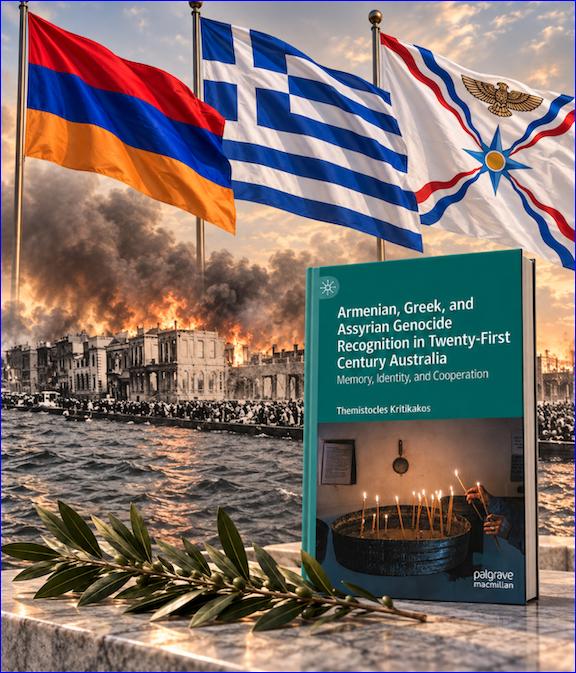
The program will introduce Dr. Kritikakos' newly published book, "Armenian, Greek, and Assyrian Genocide Recognition in Twenty-First Century Australia: Memory, Identity, and Cooperation" (Palgrave Macmillan, 2026), to a United States and Canada audience for the first time. The September program also takes place during the month commemorating the 1922 Catastrophe of Smyrna, providing a poignant historical context for a broader discussion of memory, recognition and the experiences of the Armenian, Greek and Assyrian, all Christian communities of the late Ottoman period.
The public is invited to attend this timely conversation examining genocide recognition, historical memory, intergenerational trauma and the ways Armenian, Greek and Assyrian diaspora communities have increasingly worked together to preserve their histories and pursue recognition.
Dr. Kritikakos' book offers the first comprehensive comparative analysis of the legacies of the genocides of Armenians, Greeks and Assyrians during the late Ottoman period (1914 to 1923) and the subsequent movement for recognition in Australia.
While the Armenian Genocide has achieved significant international recognition, the genocides of Greeks and Assyrians remain comparatively little known. Dr. Kritikakos examines how the three communities have remembered these experiences, how those memories have been transmitted from survivors to succeeding generations, and how histories once commemorated largely separately have increasingly converged into shared narratives and cooperation.
Australia provides a particularly compelling setting for this history. Australians witnessed, documented and responded to atrocities against Armenian, Greek and Assyrian populations, including through humanitarian relief efforts. At the same time, Australian national narratives shaped by Gallipoli and later reconciliation with Turkey have remained in persistent tension with genocide recognition.
Drawing on oral-history interviews with descendants of survivors and scholarship in memory and genocide studies, Dr. Kritikakos explores the lasting effects of intergenerational trauma and silence, the formation of diaspora identity, commemoration, collective memory and intercommunal cooperation.
His work raises questions that continue to resonate across diaspora communities: How are traumatic histories passed from one generation to another? What happens when families remain silent about their experiences? How can communities preserve memory as the survivor generation disappears? And what can be achieved when communities with parallel histories work together?
In her foreword to the book, Professor Joy Damousi AM, one of Australia's leading historians, describes the work as a "highly original, incisive and powerful intervention into current debates about genocide recognition."
The September 26 program offers audiences in North America an opportunity to meet Dr. Kritikakos, learn about this important new scholarship and participate in a broader conversation about memory, recognition and cooperation among Armenian, Greek and Assyrian communities. Members of all communities are invited to attend.
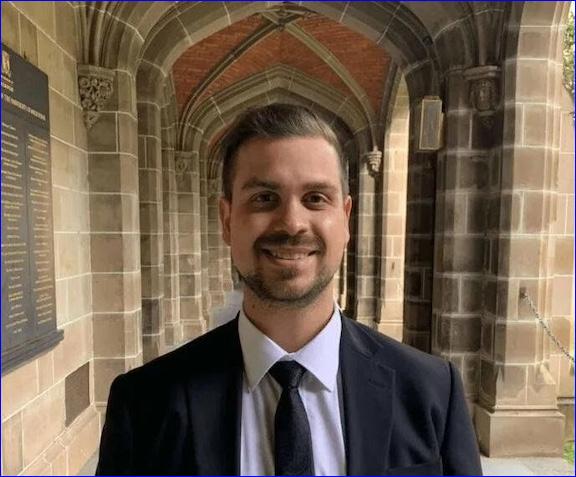
Dr. Themistocles Kritikakos is a Greek-Australian historian and writer who holds a PhD in History from the University of Melbourne. His research focuses on genocide, memory, intergenerational trauma, identity and diaspora communities.
Dr. Themistocles Kritikakos is the author of "Armenian, Greek, and Assyrian Genocide Recognition in Twenty-First Century Australia: Memory, Identity, and Cooperation," published by Palgrave Macmillan in 2026.
The author examines the enduring legacies of the Armenian, Greek, and Assyrian genocides in the late Ottoman Empire (1914 to 1923). This book presents the first comprehensive comparative analysis of their efforts to achieve genocide recognition in Australia, advancing our understanding of the Ottoman genocidal campaign and its long-term consequences. The book is available at: Amazon.com and via eBook.
The Hellenic American Women's Council is a 501(c)(3), nonpartisan, nationwide network whose mission is to identify and harness the tremendous talents of Hellenic American women. HAWC encourages awareness of public policy issues and promotes women who seek leadership roles in their communities, the nation and their professional fields.
HAWC sponsors regional conferences, lectures, debates and seminars featuring prominent scholars, government officials and experts on issues of interest and importance to its members and the broader Hellenic American community. Its regional chapters provide educational and cultural programming while strengthening connections among Hellenes in the United States, Greece and the global diaspora. For additional information, visit their website.
Established in 1985, Hellenic Link--Midwest is a professional organization in the Chicagoland area linking Hellenes and Philhellenes through cultural, scientific, social and philanthropic activities.
For more than four decades, the organization has presented lectures, symposia and conferences on subjects at the forefront of Hellenic-American interests. Its programs have featured ambassadors, journalists, university professors and other distinguished speakers addressing Hellenic history and contemporary issues in politics, economics, education, the arts and sciences. For more information, visit the website.
or register to post a comment.