


For the Assyrian diaspora, preserving the language has become about far more than words. It is about safeguarding history, faith, culture, and identity.
In Belgium, where an estimated 20,000 Assyrian households have built new lives over the past decades, a group of educators and community leaders believes that the classroom may be the most powerful place to ensure that this ancient heritage survives.
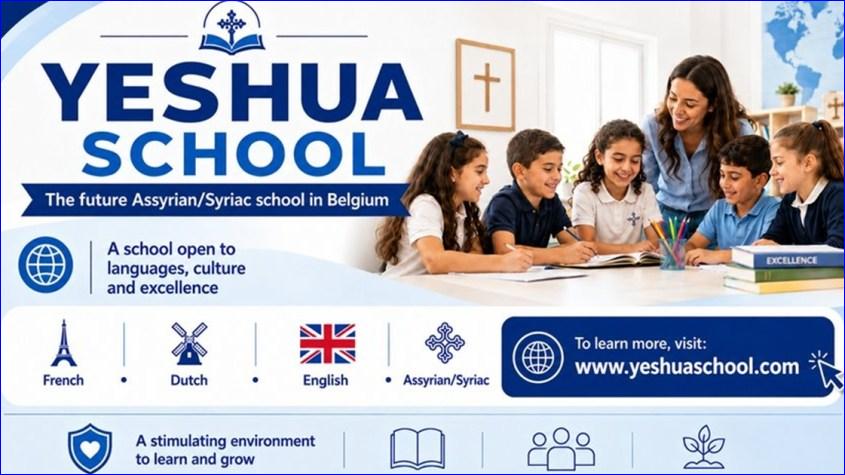
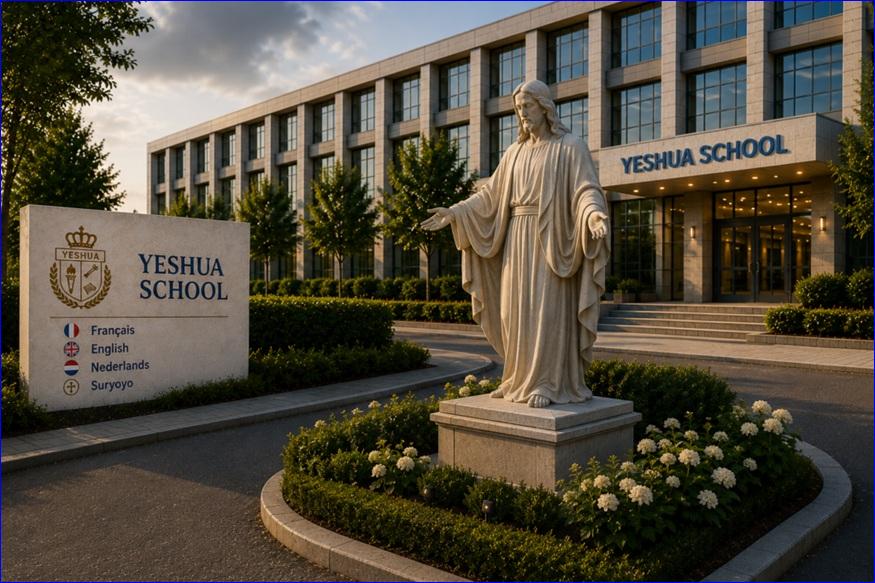
Their answer is Yeshua School, an ambitious educational project that aims to become Belgium's first school to integrate Assyrian into a full quadrilingual curriculum alongside Dutch, French, and English. Scheduled to open on the outskirts of Brussels in September 2029, the school is designed not only to educate children but also to preserve a civilization's living voice.
Leading the initiative is Lena Ors, an archaeologist and founder of Yeshua School, whose professional life has been devoted to studying the past and whose latest mission is to help secure its future.
"The idea was born from two realities," Ors told SyriacPress. "Belgium is home to approximately 20,000 Assyrian households, yet no school teaches Assyrian. At the same time, younger generations are gradually losing their mother tongue. We wanted to respond to both challenges by creating an accessible Christian school where children receive an excellent education while preserving their language and heritage."
A Language Older than Nations
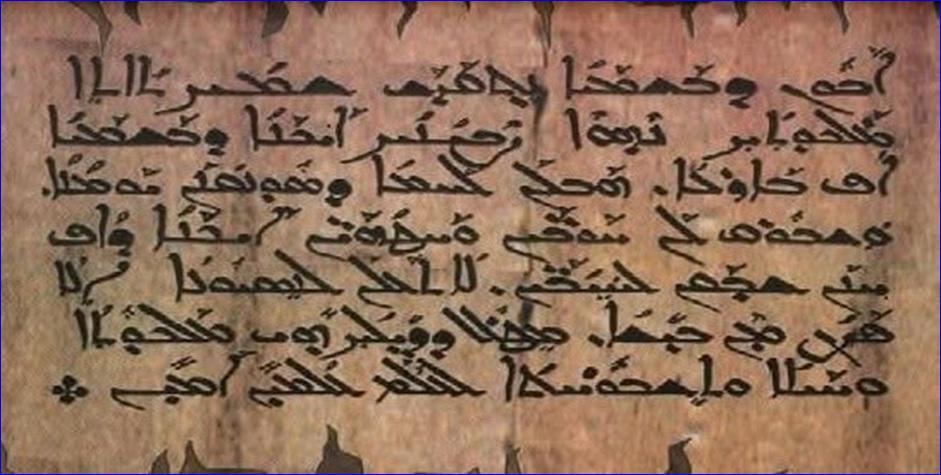
Long before many modern states existed, Assyrian served as one of the principal languages of Christianity across Mesopotamia and the Near East. It became the language of theology, philosophy, science and literature, carrying knowledge across civilizations through centuries of translation and scholarship.
Today, however, the challenge is no longer producing literature but ensuring children continue speaking the language at all.
Across Europe, Assyrian families often rely on churches and volunteer organizations to teach the language after regular school hours. Children attend mainstream schools during the day before travelling several evenings each week to church classes for Assyrian instruction--a demanding routine for both parents and students. Yeshua School seeks to change that reality. Instead of separating language from education, Assyrian will become part of everyday school life from kindergarten through primary education.
"The language should not survive only inside churches," Ors said. "It deserves a place inside classrooms, where children can grow up using it naturally."
The school's name itself reflects that philosophy. "Yeshua" is the Aramaic name of Jesus, bringing together the project's two central pillars: Christian faith and the Assyrian language.
Education Designed for Modern Families
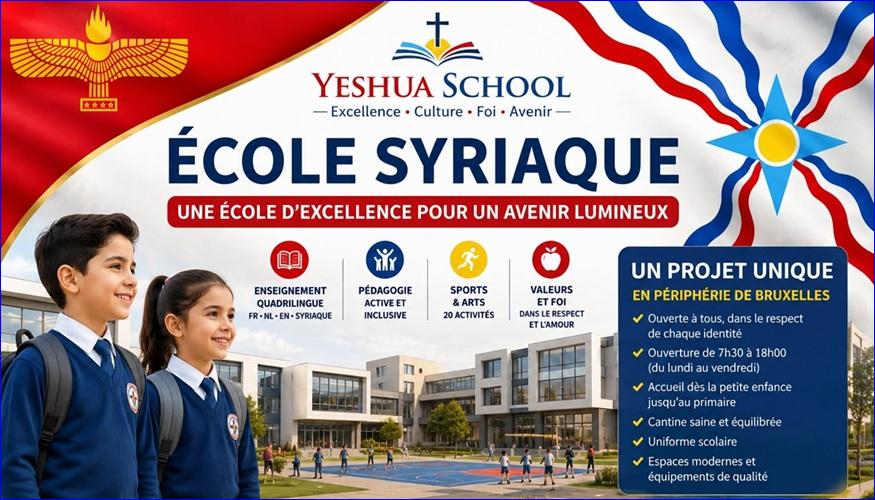
Yeshua School proposes a model rarely seen in Belgium. Children will be welcomed from 7:30 each morning with breakfast before formal lessons begin at 9:00 a.m. A hot organic lunch will be served daily, while afternoons will combine academic studies with nearly thirty extracurricular activities, including football, music, drama, gardening, cooking and the arts. The school will remain open until 6:00 p.m., providing working parents with a complete educational environment throughout the day.
"We want families to know that their children are welcomed, cared for, well-fed and inspired from morning until evening," Ors explained.
The educational philosophy is equally distinctive. Drawing on the Freinet educational method, developed by French educator Célestin Freinet, and enriched by Montessori principles, the school emphasizes cooperative learning, creativity, critical thinking, and individualized education rather than rote memorization or punitive discipline. Flexible classrooms, peer learning, and inclusive teaching are intended to allow every child to develop according to his or her own strengths.
Academic success, however, is only part of the vision. "We want our pupils to become fulfilled young people who know who they are, remain rooted in their values and are open to the world," Ors said.
Four Languages, One Identity
Unlike many multilingual schools that focus solely on international competitiveness, each language at Yeshua School serves a distinct purpose. Dutch prepares pupils for life in Flanders. French connects them with nearby Brussels. English equips them for an increasingly global world. Assyrian preserves their cultural identity. Together, the founders believe, the four languages complement rather than compete with one another.
Beyond language lessons, students will also explore Assyrian and Mesopotamian history through music, cultural celebrations, and community life.
Looking beyond the school itself, Ors also hopes one day to establish a Assyrian Linguistic Research Centre, dedicated to advancing the study, preservation and development of the language for future generations.
A Growing International Movement
Yeshua School is not emerging in isolation. Across the Assyrian diaspora, educators have increasingly sought to institutionalize Assyrian language education. In Sweden, Edessaskolan in Hallunda-Norsborg became Europe's first Assyrian school in 2008, combining Sweden's national curriculum with dedicated instruction in Assyrian language and music. Its founders viewed education as essential to preventing linguistic assimilation among younger generations.
In the United States, several schools in Illinois have also introduced Assyrian into their curricula, reflecting growing recognition of the importance of preserving one of Christianity's oldest living languages. In Australia, the Saint Hurmizd Assyrian Primary School (since 2002) and Saint Narsai Christian College (since 2006) serve the educational needs of hundreds of children of the Assyrian community.
For Ors, these developments demonstrate that preserving Assyrian requires long-term educational institutions rather than temporary initiatives.
Community Confidence
Perhaps the strongest endorsement of Yeshua School has come from families themselves. A market survey conducted in 2023 among 260 Assyrian households found that 97 percent supported the creation of a quadrilingual Assyrian school. Today, more than 200 children have already been pre-registered, despite the fact that the school has not yet opened its doors.
"What moves us most," Ors said, "is hearing parents and grandparents say that their children will finally learn, at school, the language they themselves only encountered at home or in church. Many tell us: 'At last, a school that reflects who we are.'"
The founders expect to welcome 484 pupils during the school's opening phase before eventually expanding to more than 1,000 students through the addition of secondary education.
Building the Future
Transforming that vision into reality remains a significant undertaking. The total investment is estimated at almost 9 million euros, including the purchase and renovation of an existing building and the equipment needed to create a modern educational campus.
Assuming approval of infrastructure support from the Flemish Government, the project's non-profit organization must still raise approximately 2.67 million euros. Around 200,000 euros have already been secured, largely through contributions from the founders' families and early supporters.
Yet for Ors, fundraising is only one part of a much larger mission. "As an archaeologist, I understand that language is the memory of a civilization," she said. "A language that is no longer taught is a language that dies--and with it disappear centuries of history, faith and culture. But every child who learns Assyrian gives that heritage a future."
Whether Yeshua School ultimately becomes a single campus outside Brussels or inspires similar institutions throughout Europe remains to be seen. But for the hundreds of families who have already placed their trust in the project, its purpose extends beyond education. It is an investment in identity. A commitment to heritage. And perhaps most importantly, a promise that one of humanity's oldest languages will continue to be spoken--not only in churches or family homes, but in classrooms filled with the voices of a new generation.
or register to post a comment.