


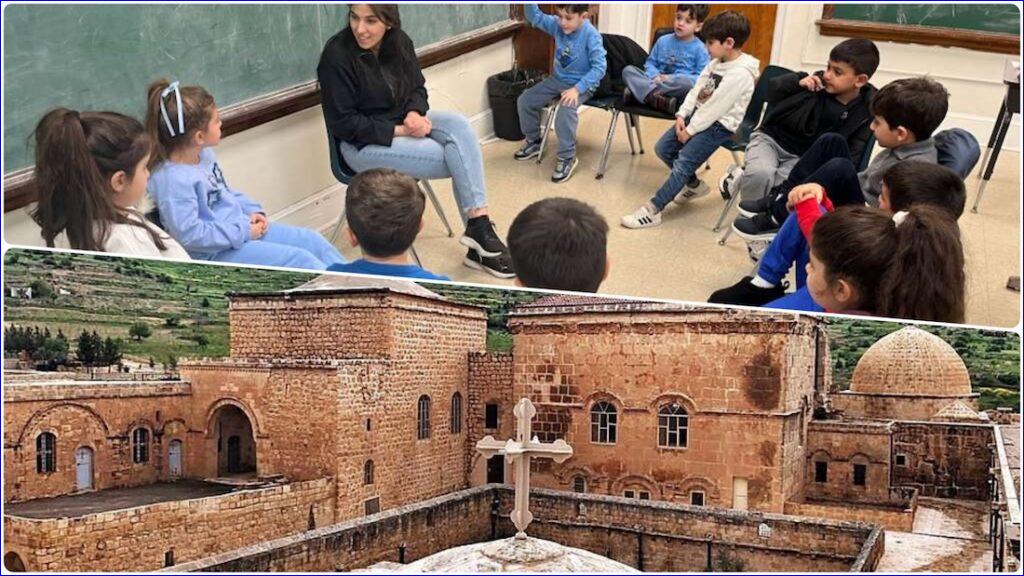
What I did not expect to find was something far more remarkable: a living ecosystem devoted to preserving the Syriac language itself.
Syriac is a classical form of Aramaic, the language historically associated with the life of Jesus and with the earliest centuries of Christianity. For nearly two thousand years, Syriac has served as a language of theology, liturgy, poetry, and everyday speech among Syriac Christians of the Middle East, especially in Tur Abdin in southeastern Turkey and neighboring regions. Today it is often described as endangered, preserved mainly in church services or among older generations scattered across the diaspora.
Yet what I encountered in New Jersey challenged that assumption.
Every Friday evening, more than 150 children gather in a rented Catholic school building to study Syriac. They range in age from five to early teens. They come after a full week of school, sports, and homework, yet they sit in classrooms learning to read, write, and speak a language that first took written form nearly two millennia ago.
The program is called "Madrashto," a Syriac word which simply means "school." More than a classroom, the Madrashto at Mor Gabriel Syriac Orthodox Church in Haworth, New Jersey functions as a cultural and spiritual training ground where language, faith, music, and identity come together.
Mor Gabriel--"Mor" being an honorific title used for saints in the Syriac tradition--is one of the largest Syriac Orthodox churches in the United States. What began about thirty years ago as a small congregation of immigrant families has grown into a thriving community of more than two hundred families. With that growth came a determination not only to build a church, but to preserve the language that has always been inseparable from their faith.
My own involvement in teaching Syriac began almost unexpectedly. What I witnessed there reshaped my understanding of how a language survives--not only through formal instruction, but through community, worship, and the shared commitment of parents, teachers, and children who refuse to let their heritage fade.
In a time when minority languages are often described only in terms of decline, the experience of this community raises a different question: Is Syriac truly disappearing, or is it being reborn on new soil?
The Madrashto's Formula
The Madrashto at Mor Gabriel operates without the structure one might expect from a formal school. It has no government recognition, no standardized curriculum, and no paid faculty. Yet every week it functions with remarkable organization and consistency.
More than forty volunteer teachers give several hours of their time each week. Classes are arranged by age and level. Younger children learn the Syriac alphabet and basic reading, while older students study grammar, liturgical texts, and spoken forms of the language. Instruction often takes place almost entirely in Syriac, reinforcing both literacy and conversation.
The program does not rely on a single textbook or method. Some teachers use traditional materials brought from the Middle East, while others adapt lessons to fit the needs of children growing up in America. Classical Syriac, the literary form used in church texts, is taught alongside Turoyo, the spoken dialect many families still use at home. Balancing these forms is not always easy, but it reflects the linguistic reality of the community.
What makes the Madrashto especially effective is that language learning does not end in the classroom.
Classes are scheduled before evening prayers so that students can immediately use what they have learned. On Saturdays, older children practice psalms and hymns. On Sundays, many of the same students read, chant, or serve during the liturgy. In this way, Syriac is not treated as an academic subject but as a living language heard in prayer, music, and everyday conversation.
The program is sustained entirely by the community itself. Parents insist that their children attend even when they would rather be elsewhere. Teachers prepare lessons after work. Older students help younger ones. The expectation is simple but firm: if the language is to survive, every generation must take responsibility for it.
This approach reflects the traditional educational culture of Tur Abdin, where language was never learned only in school but through family, church, and daily life. The Madrashto recreates that environment in the diaspora.
Another key to its success is flexibility. Teachers often adapt vocabulary and materials to fit modern life while remaining faithful to tradition. Guides and teaching resources have been developed to provide consistent terminology for school, church, and daily activities. These efforts help ensure that Syriac can be used not only in liturgy but also in ordinary conversation.
Even without formal training programs, the teachers share a clear goal: Syriac must be spoken, heard, and lived, not only studied.
Because of this, the Madrashto has become more than a language class. It is a place where children learn who they are.
What This Means for Syriac in the Diaspora
For decades, Syriac has often been described as a dying language. Linguists classify it as endangered, and in many places that description is accurate. In the ancestral homeland, war, migration, and economic hardship have reduced the number of speakers. In the diaspora, younger generations often grow up speaking English more comfortably than the language of their parents.
Yet the experience at Mor Gabriel shows that decline is not the only story.
When language is connected to faith, family, and community life, it can survive even far from its original homeland. The Madrashto demonstrates that preservation does not depend only on institutions or governments. It depends on people who believe the language matters.
In this community, Syriac is heard everywhere: in prayers, in hymns, in announcements, in conversations after church. Children hear it from their parents, their teachers, their priests, and their friends. They grow up understanding that the language is not only a relic of the past but part of their identity.
The growth of the church itself reflects this connection. As the congregation expanded, the Madrashto expanded with it. New classrooms were added, more teachers volunteered, and more children enrolled. The desire to keep the language alive became a source of unity for the community.
This experience suggests that language preservation requires more than academic programs. It requires immersion, repetition, and emotional attachment. When children learn Syriac through prayer, song, and shared tradition, the language becomes part of their memory in a way that textbooks alone cannot achieve.
It also shows that the diaspora can become a place of renewal. Far from the mountains of Tur Abdin, families in New Jersey are building an environment where Syriac can still be spoken, sung, and taught.
There is even greater potential for the future. A unified curriculum shared across diaspora churches could strengthen instruction. Teacher training programs could help volunteers build on what they already do so well. Summer courses, cultural programs, and language certificates could reach new generations. Interest from outside the Syriac community could also grow, introducing more people to one of the oldest living traditions of Christianity.
None of this would replace the spirit that already sustains the Madrashto. Its strength comes from the fact that it began not as an institution, but as a commitment.
On Friday evenings, classrooms fill with the voices of children reading Syriac aloud--sometimes slowly, sometimes laughing at unfamiliar words, sometimes repeating lines until they can say them without looking at the page. On Saturday nights those same voices chant psalms. On Sunday mornings they stand in church and sing hymns first heard centuries ago in the Middle East.
This is not what a dying language looks like. It is a sign of an ancient language in renewal. It is an awakening through the voices of children who speak the words of their ancestors, in the songs that carry memories across generations, and in the faith of a community that believes its language is worth preserving.
In the diaspora, Syriac is not only surviving. It is being reborn.
Gabriel Aydin, PhD, is a musicologist, author, and composer specializing in Syriac liturgical chant and the musical traditions of the Christian Middle East. He is the founder of the Syriac Music Institute, creator of the Syriac Hymnal App, and teaches Classical Syriac. His research focuses on the modal and historical structures of Syriac sacred music.
or register to post a comment.