


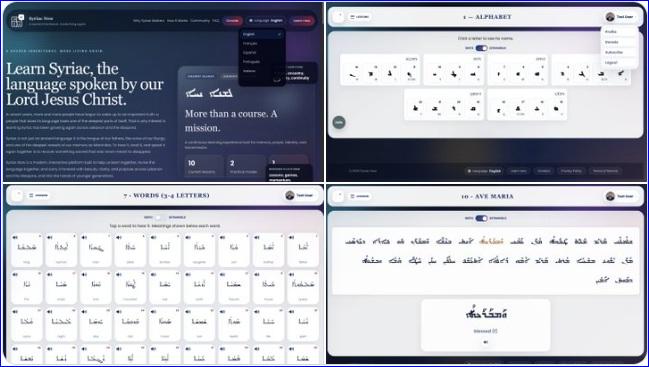
Today, artificial intelligence tools and modern technological advancements are being leveraged to help safeguard this language. Mario Dayba, publisher of the website "Christian Lebanon" -- considered a national civic movement aimed at organizing Lebanese Christians into a structured, transparent, and capable community -- has announced the development of a new online educational platform dedicated to teaching Syriac. The initiative is being carried out in collaboration with a select group of leading Syriac language instructors in Lebanon.
In a statement posted on X, Dayba noted that the platform is currently in its final testing phase and is expected to be officially launched within the next few days.
In previous opinion articles, Dayba emphasized:
Every people is first defined by its language. Borders can shift. Parties can rise and fall. Institutions can be captured. But language is the deepest marker of continuity, because it carries the way a people names the world, prays, argues, remembers, and teaches its children. When a language retreats, a people does not disappear overnight. It dissolves quietly, one generation at a time, into the stronger cultural current around it. That is why Syriac is not a 'heritage project.' It is an identity project, and identity is not decoration. Identity is survival.
He also stressed that Lebanese Christians need to return to their historical language, not through an abrupt transformation, but through a long-term and serious process of restoration.
Language can gradually become part of everyday life if it is embraced beyond its traditional settings, Dabya said. He explained that the first step is moving it from a language associated primarily with clergy into one used within families, followed by a shift in which children come to see it as something normal rather than unfamiliar. Over time, he added, it can evolve into a shared point of reference across regions and communities.
Dabya stressed that this is how identity is sustained -- not through rhetoric, but through daily practices, such as what people read, sing, display in public spaces, and pass on within their homes.
or register to post a comment.