


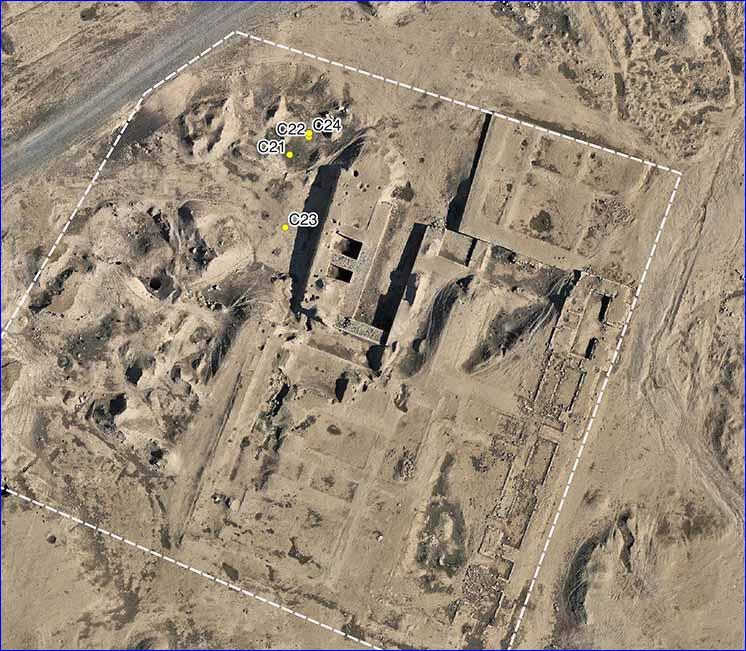
 Mark Altaweel)
The researchers behind the discovery date the temple's foundation to between 2896 BCE and 2702 BCE, saying that it provides crucial evidence for the spread of Mesopotamian ritual practice to northern Iraq and urban life at Assur over 4,700 years ago, revealing the growth of cult worship.
The findings were published in The Journal of Archaeological Science: Reports.
Assur's Ishtar Temple
Assyria was a major Mesopotamian civilization that began as Assur--initially a meager city-state--and eventually expanded into a much larger empire.
The city itself is located on the western bank of the Tigris River, and during the first millennium BCE, the Neo-Assyrian empire became well established, leaving a rich corpus of well-preserved records about these later periods. Yet, earlier records are murkier or nonexistent, leaving Assur's beginnings shrouded in mystery.
German archaeologist Walter Andrae first excavated the Ishtar Empire between 1903 and 1914. However, the deepest layers remained covered until the Ludwig Maximilian University of Munich's Assur Excavation Project in 2024. Modern coring technology has enabled archaeologists to access the temple cella.
"The excavators of the Ishtar temple simply didn't report it, so we assume they didn't see it," lead author Mark Altaweel told The Debrief in an email. "The sand is below the last floor level of the temple, so it is possible they just didn't dig far enough or reach the bedrock. We basically cored until we hit the bedrock."
Examining the Sediment
During the excavation, archaeologists collected sediment cores from the earliest portion of the site, known as Temple H. In this core, they identified a meter-thick layer of sand capped by a layer of charcoal beneath the foundation. The charcoal was radiocarbon-dated to between 2896 BCE and 2702 BCE, during the Early Dynastic I period, and represents the earliest known occupation level in the city.
Intriguingly, the sand appears to be collected from local aeolian deposits of glaucophane, zoisite, and lawsonite, sourced from the blueschist-facies metamorphic rock of the Zagos Mountains. These deposits were inconveniently located on the far side of the Tigris. According to the researchers, this suggests that the Assyrians deliberately chose this material for its geological properties over the more readily available materials found nearby.
"Sand near the city of Assur was more mixed with sediment and would require more work or levigation," Altaweel said. "Basically, the more distant sand seems much more pure and cleaner than the sand nearby or maybe just required less work to clean. Pure looking sand would have been an important quality if the goal was sanctity of the temple."
Purifying Ishtar's Temple
This sand was no mere building material; its placement also served as a ritual purification, preparing the ground before erecting a sacred structure. While such practices have previously been identified in southern Mesopotamia, this is the first known instance to be observed in the north, indicating that northern Mestopamians were not adopting the south's cultural practices, yet they managed to implement them using locally available materials.
"To me, the main thing is it looks similar to sand you have in southern Mesopotamia (S. Iraq), where similar sand to this is more available and widespread," said Altaweel. "I think the sand was chosen for its visual qualities, and the source found some distance from Assur was, in my mind, among the best sand to use for the visual quality."
"My first thought when I saw the sand was it looked like sand you get in southern Iraq. Practically, sand can be used to prevent moisture from coming up into a building," Altaweel added. "So it is possible they did this for a functional reason as well. I am not sure they put sand for that purpose though, since they didn't seem to do it elsewhere that we can see. The elevation is also somewhat high so the ground should have drained well."
Origins of the Cult of Ishtar
"The temple itself is similar in design to southern temples and there were statues found there that resemble southern Mesopotamian styles, which is why I suspect the founders were heavily influenced by that region (perhaps even came from that region) and Ishtar/Enanna from southern Mesopotamia," said Altaweel.
From the sacred layer of sand to architectural styles, the Ishtar temple in Assur demonstrates the cult's spread throughout the region.
"The earliest evidence for Ishtar (Eanna) comes from one of the earliest cities on Earth, Uruk in southern Iraq," Altaweel explained. "Sometime, probably around or after 3500 BCE, we know the Ishtar/Eanna cult likely spread, including to Northern Mesopotamia."
"What we see at Assur could be influence from an earlier period that has been hard to track," Altaweel concluded, adding that "the results document the popularity and spread of Ishtar early in recorded history."
The paper, "The Sand Deposit Underneath the Ishtar Temple in Assur, Iraq: Origin and Implications for the Foundation of the Goddess's Cult and Sanctuary," appeared in The Journal of Archaeological Science: Reports on January 14, 2026.
or register to post a comment.