


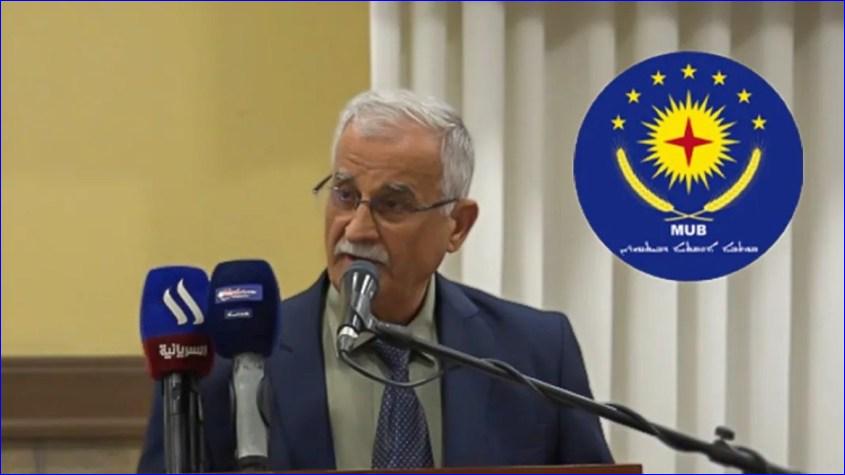
At the outset, I extend my sincerest congratulations and best wishes to the honorable members of parliament who won the Christian quota seats in the Iraqi Council of Representatives, representing our Chaldean--Syriac--Assyrian people, namely, MP Imad Youkhana -- Kerkeslokh (Kirkuk) Governorate, MP Keldo Ramzi -- Arba'ilo (Erbil) Governorate, MP Sami Oshana -- Nohadra (Duhok) Governorate.
Their arrival in parliament constitutes a democratic entitlement, which we hope will serve the causes of our people and their constitutional and historical rights.
However, a legitimate and pressing question arises in this context. Why has a religious designation (the "Christian Suyana Bloc") been introduced and adopted within a legislative institution that is supposed to be based on political and national representation, not religious identity?
Our people -- the Chaldean--Syriac--Assyrian people -- are a nation with a deeply rooted national identity that predates the emergence of Christianity itself and that contributed to the building of some of the most ancient human civilizations: Akkad, Sumer, Babylon, and Assyria.
While the Christian faith today constitutes the spiritual and religious bond among the communities of our people, this does not negate their national identity, nor does it justify reducing them to a purely religious label within state institutions.
Transforming political representation from a national designation into a religious one raises genuine concerns about reproducing policies of marginalization that our people have historically suffered from, most notably what occurred at the Lausanne Conference in 1923, when their national identity was ignored and replaced with religious descriptions, leading to the erasure of their historical and national character at the regional and international levels.
We take pride in our Christian faith, in our Lord Jesus Christ -- to Him be all glory -- and in His salvific message founded on love, truth, and justice.
Yet religious faith, in its essence, is a spiritual and moral message, not a political instrument nor a parliamentary label.
As Christ Himself said, "Render to Caesar the things that are Caesar's, and to God the things that are God's," a clear indication of the separation between faith and temporal authority.
Introducing religious labeling into parliamentary work may burden religion with what it cannot bear and place it within the arena of political polarization -- something that serves neither faith nor national representation.
From this standpoint, we issue a responsible call to the representatives of our people in the Iraqi Parliament to reconsider this designation and to adopt a description that reflects the historical national identity of our people, in line with the rest of Iraq's components, which are politically represented by their national -- not religious -- identities.
Defending rights is incomplete without protecting the name; and the name is not a superficial detail, but rather a title of existence, history, and legitimacy.
What we put forward is neither a questioning of intentions nor a diminishment of efforts. Rather, it is a call for awareness and responsibility, so that we do not gain political positions while losing our national selves, in accordance with the profound Gospel question:
What will it profit a man if he gains the whole world and loses his own soul?
or register to post a comment.