


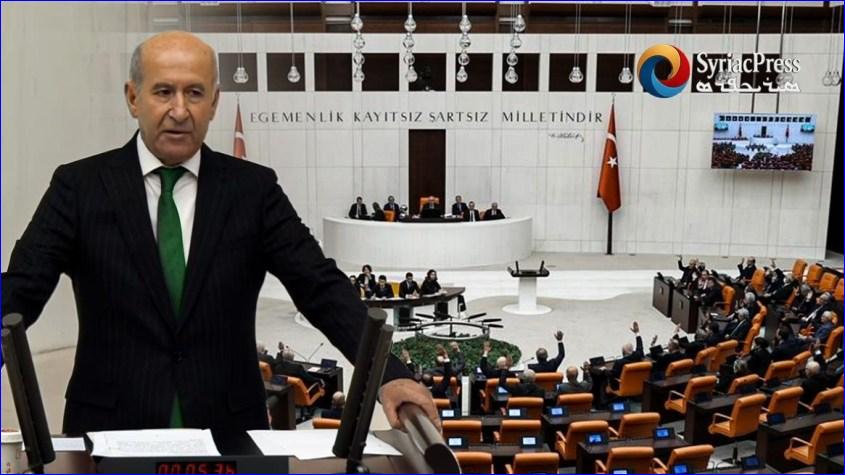
Assyrian Member of Parliament from the Peoples' Equality and Democratic Party (Halklarin Esitlik ve Demokrasi Partisi, DEM Party) George Aryo (state-imposed Turkish surname Aslan) renewed these demands in a statement delivered before the Parliament, addressing fellow MPs and Minister of Culture and Tourism Mehmet Nuri Ersoy. Speaking not only on behalf of the Assyrian people but also for all non-Turkish communities, Aryo stressed that the Ministry of Culture "is a key institution responsible for protecting Turkey's historical heritage." Under the law, he said, the ministry is obligated to identify, protect, restore, and make historical buildings accessible to the public regardless of religious or ethnic affiliation.
Aryo argued that the reality on the ground stands in stark contrast to these legal obligations, pointing to what he described as a discriminatory approach based on "who is like us and who is not." He said this was not simply a matter of neglect, but a conscious and systematic policy. "Throughout the history of the Republic, cultural policy has been administered with a single, exclusionary mindset," he said, adding that the Ministry of Culture and Tourism has been among the institutions implementing this approach.
While restoration work has been carried out on many historical buildings certain communities have been consistently excluded from these efforts, Aryo stated. He called on the minister to take responsibility for protecting all places of worship, including mosques, churches, cemeteries, and synagogues, as well as all historical sites, without discrimination.
Aryo noted that Turkey currently has 167 institutions belonging to non-Turkish communities: 77 affiliated with the Greek (Rûm) Orthodox Church, 54 with the Armenian Church, 19 with the Jewish community, 10 with the Syriac Church, 3 with the Chaldean Church, 2 with the Bulgarian Church, 1 with the Georgian Church, and 1 with the Syriac Maronite Church. These institutions, he said, have existed from the Ottoman era to the present and play a vital role in preserving language, religion, education, health services, and social solidarity among Christian and Jewish communities in Turkey.
He also referred to the Treaty of Lausanne, which explicitly recognized Armenians, Greeks, and Assyrians as minorities in Turkey and guaranteed their religious, educational, cultural, and property rights. Aslan criticized the fact that more than a century later, "many of these rights remain ink on paper," while the property rights of minority institutions have been severely restricted. He explained that various legal regulations and administrative decisions led to the confiscation of institutional properties and the annulment of title deeds, causing not only economic losses but also serving as a tool of pressure against minority communities. Although the 1936 Declaration was intended to register minority-owned properties, its later interpretation allowed for the confiscation of properties acquired after that date, resulting in the transfer of residences, schools, and churches to the public treasury or third parties.
Addressing the neglect of historic Syriac religious centers, Aryo recalled that for centuries the seats of the Syriac Orthodox and Syriac Catholic patriarchates were located in the city of Merde (Mardin). Due to the failure to protect and maintain these sites, he said, the patriarchates were forced to relocate to Syria and Lebanon about a century ago. He noted that the building of the Syriac Catholic Patriarchate, now known as the Mardin Museum, belonged to the Syriac Catholic foundation until 1989, when it was converted into a museum. According to information received from foundation officials, Aryo said there is a possibility the building may be returned to its original owners, calling such a move an important step and urging that it be completed as soon as possible.
Aryo also raised concerns over foundation elections, noting that while elections are normally held every five years, some institutions have not conducted them for decades. He cited the Balikli Greek Hospital Foundation in Istanbul, where elections have not been held for 35 years due to the absence of regulations governing minority charitable foundation hospitals. With some board members now between 85 and 90 years old, Aslan stressed the urgency of drafting and issuing the necessary legal regulations without further delay.
or register to post a comment.