


We also remember the 133 Assyrian villages eradicated during the Anfal campaigns, whose people fought alongside the Kurdistan Democratic Party in a shared struggle for all inhabitants, irrespective of creed or ethnicity. This tribute stands in stark contrast to the perpetrators of those campaigns -- some former collaborators of the Saddam regime -- who are now celebrated as national heroes within Kurdish political circles and wield privileges exceeding those they enjoyed under the previous dictatorship.
We honor the memory of the countless families who suffered displacement, death, or imprisonment while fighting to protect both themselves and their Kurdish neighbors -- a commitment the Party itself invokes when describing its dedication to "the martyrs' bloodshed in the struggle for liberation."
Let me now summarize the reality of how the esteemed Party applies its slogan of "Shared Living and Coexistence" on the ground toward an indigenous people rooted in the land of its ancestors for thousands of years. Actions, not words, are the true measure.
In practice, the Party confiscates the land of this people under the pretext of development and urbanization, offering no compensation in return. It encourages Kurdish tribes -- many of whom were once collaborators with Saddam's regime -- to encroach upon villages in Nohadra (Duhok), Arba'ilo (Erbil), and surrounding areas, rewarding such encroachment with political loyalty.
It exploits technical deficiencies in both regional and federal electoral codes to seize seats reserved for minority representation, then installs pliable and ineffective individuals who nominally represent the Assyrian community but in reality function as political instruments advancing the Party's own interests. It manufactures puppet parties with no popular base, dispenses token resources, and deploys them as auxiliary tools in intra-Kurdish rivalries and in conflicts with both Shia and Sunni Arab factions.
The Party also instrumentalizes select Christian clergy -- outwardly devout and adorned with prominent crosses, yet inwardly disloyal -- who facilitate the exploitation of the Church and its congregation. These figures act as propagandists, publicly praising the party's transgressions across media platforms while falsely claiming to represent the community. At the same time, the Party turns a blind eye to attacks on churches, the desecration of Christian symbols, and the vandalism of Christian cemeteries within its jurisdiction. It provides political cover for Kurdish militants implicated in a violent machete attack on an Akitu procession and refuses public accountability despite clear evidence of their guilt. It further grants official licenses to civil society organizations whose sole purpose is to promote hatred and incitement against this people.
Beyond this, the Party has expanded its influence into Nineveh Plains, actively promoting narratives among some community members that advocate autonomy for the region and their eventual integration into the Kurdistan Region of Iraq.
It shields religious clerics who issue fatwas of apostasy against Christians and Yezidis, ensuring that they face no legal consequences. Even within the ministry ostensibly allocated to Assyrian affairs, it appoints ministers who hold official membership in the ruling Kurdish party, reinforcing the absence of genuine representation.
Its broader strategy relies on a calculated combination of coercion and cooption aimed at silencing Christians who dissent from the Party line.
It systematically ignores -- and in some cases rewards -- efforts to appropriate and rewrite Assyrian history as Kurdish.
It glorifies the assassin and betrayer of an Assyrian Church leader as a Kurdish nationalist icon and embeds this revisionist narrative into the educational curriculum imposed on the community's youth.
While securing substantial international funding under the banner of coexistence, the Party allocates only a negligible fraction of those resources to organizations whose primary function is to legitimize and celebrate its minority-protection façade. All the while, it advances a rhetoric of imposed gratitude, implying that this indigenous community should consider itself fortunate merely to survive and to remain on its own ancestral land.
Given its apparent success, should this exemplary model of "coexistence and shared living" not be recommended to policymakers in the United States, the European Union, and across the Middle East for wider application?
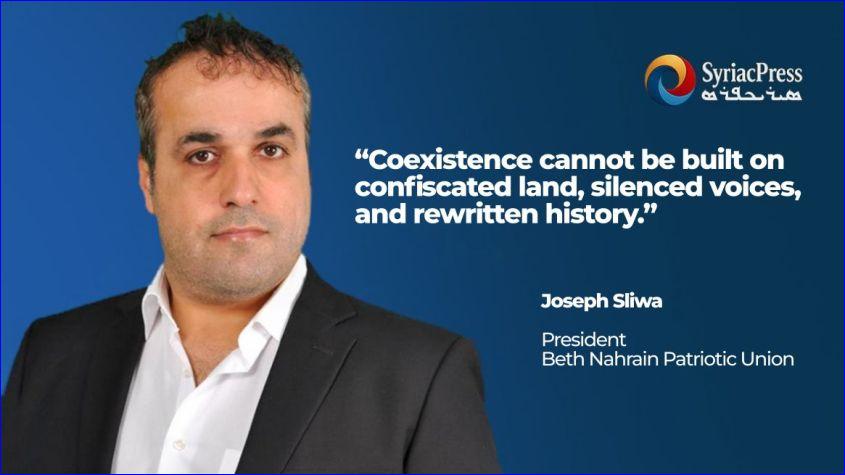
Joseph Sliwa is President of the Beth Nahrain Patriotic Union and member of the third-term Federal Parliament.
or register to post a comment.