


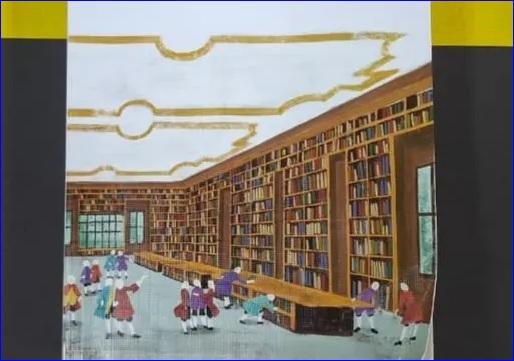
British historians Andrew Pettegree and Arthur der Weduwen in The Library: A Fragile History (2021) which was translated as The Library: A Fascinating Exploration of Library History from the Ancient World to the Digital Age (Alvabet, 2025) reveal how the development of libraries in the world has changed due to several external factors.
Victims of the Invasion of Roles
This 600-page publication traces the exploration of the two authors starting from the time of Mesopotamia, where tens of thousands of clay tablets were stored by the Assyrian Empire in the Palace of Nineveh. The authors consider this library to be the oldest library that ever existed, rather than the Library of Alexandria in Egypt as many people believe. Unfortunately, between 614--612 BC, the collection of the Assyrian library was destroyed when the empire was conquered by Babylon.
The destruction of books, also known as bibliocide, also occurred at the Library of Alexandria. However, in this book, the two authors offer several theories regarding the destruction of the Alexandria library collection. First, the fire that was allegedly accidental caused by Julius Caesar's troops in 48 BC. This version is sourced from Plutarch. Second, the invasion by Emperor Aurelian in 272 AD, which also devastated the palace, including the library area. Third, during Emperor Theodosius's military operations against pagan buildings in 391 AD, which also targeted the library. Lastly, there is a version of destruction that is actually rejected by both authors, which occurred during the Arab conquest of Egypt in the 7th century by Caliph Umar.
Among the various theories mentioned above, interestingly, Pettegree and der Weduwen propose a different theory regarding why thousands of papyrus collections in Alexandria were destroyed. They suspect that intentional neglect caused the giant library to slowly perish due to a lack of maintenance. Humidity and mold became the main culprits of its destruction. Similar stories experienced by several libraries in other regions are detailed in this book.
Although several libraries were destroyed, Pettegree and der Weduwen also demonstrate that libraries seem to experience a recurring cycle of establishment, dissemination, destruction or decay, and reconstruction. This cycle can be found in the Monte Cassino library and monastery in Italy. Despite facing repeated destruction due to attacks and earthquakes, it was always rebuilt. The same occurred with the Oxford Library in England, which was destroyed during the Protestant Reformation in 1550. However, it was rebuilt by Thomas Bodley in 1602.
Driven by Literary Works
The rise of literature in the 19th century also contributed to an increase in mass readership and fiction. This also influenced the need for reading spaces and book storage. At that time, libraries were not accessible to all social classes, particularly the working class. As a result, many readers had to use commercial libraries to read novels.
Advertisement Iklan Entering the year 1899, the public library was finally realized thanks to the assistance of a Scottish-American philanthropist who donated $5.2 million to the New York Public Library to build libraries even in small towns. The two authors reveal that after the end of World War I, libraries were able to shed their image as tools of social reform and accept their role as part of the entertainment world. The public's love for fiction made librarians aware that there was a need for a place to meet the reading needs of the public. From this point, the role of public libraries began to be enhanced.
While a fairly comprehensive overview of library development across various regions, the book is predominantly Eurocentric and American-centric. Library development in the Islamic world, Asia, and Africa receives only a limited amount of discussion. Yet, these three countries also experienced significant scientific progress, documented in books and ancient manuscripts.
Libraries vs. Digital
The existence of libraries in the digital era, according to Pettegree and der Weduwen, is greatly determined by the librarians themselves. Although patrons are now beginning to shift towards a digital ecosystem, both argue that libraries must have some form of "brake." This means that the process of digitizing collections, which is increasingly being undertaken by libraries, should not stumble over issues of copyright and public trust. They criticize the actions of librarians who discard their collections in the name of modernization. This case occurred at the San Francisco Public Library, which removed hundreds of thousands of books without consultation when moving to a new high-tech building in the 1990s.
The main ideas presented in the final chapters of this book also feel quite relevant. The common thread that can be drawn from the reading of the history of library development is that libraries endure not because of their magnificent buildings or their millions of collections, but because of the needs of their users. Once a library is no longer considered useful, it will experience decay like the Library of Alexandria or the Library of Babylon.
Another point after reading this book is the strong message from Pettegree and der Weduwen regarding the current state of libraries, which seem to be searching for their new identity. The adaptation of libraries to the ways users access books, such as providing free Wi-Fi and computer spaces, should not diminish the physical experience of its users. The strength of libraries lies in the experience of users exploring the shelves and the unexpected encounters with a book--an aspect that cannot yet be replicated by search engine algorithms. (Litbang Kompas)
Book data
- Title: The Library: A Fascinating Exploration of Library History from the Ancient World to the Digital Age
- Authors: Andrew Pettegree and Arthur der Weduwen
- Publisher: Alvabet
- Year of publication: 2025
- Number of pages: viii, 600 pp.
- ISBN: 978-623-220-225-2
or register to post a comment.